Sunday, December 27, 2015

Elevator solid state motor starters - Put one on your elevator!


We received a call this Christmas Eve night and the symptom was the starter wasn’t working properly.  Not only was this bad timing but the parts needed to begin resolving the issue where not in stock.  This particular motor starter was an across the line starter with two different starters from 1969.  What this means is that there are two separate line starters that share electrical load. 


The older style mechanical starters are fairly robust and last a very long time.  But they do age and will eventually cause problems.  The starters above have lasted almost 50 years and most likely will continue working well with the correct replacement parts.

The newer style mechanical starters are not made as well as the older style and typically do not last very long compared to their predecessors[10-15 years compared to 20-40 years].

In this particular starter you have starter contacts, coil, or auxiliary contacts that would typically be your issues why the motor starter is not working.  We have been seeing more failures of these mechanical starters lately[typically on nights and weekends-See Murphy's Law].  Being there are many different starters that all have different parts it at times causes issues getting the parts right away.  Even though we have hundreds of starters in stock it doesn’t mean the elevator service company will have the parts for your starter and without the correct parts it means your elevator will not be running until the correct parts are installed.

If you have an older building we would recommend the installation of a solid state starter.  There are a few different models of solid state starters out there but our preferred starter is a Siemens soft start. 
 
 
Benefits

Electrical savings
Ride quality improvement – Smoother operation
Less replacement parts
Advanced motor protection
No starter noise – no “bang” when elevator starts

If the building on Christmas Eve night had a Siemens soft start we most likely would have to just replace the solid state board and the elevator would have been up and running.  If you have a building and are curious if this is a good option for you, call your elevator service company and get information on a solid state starter.  The cost for the installation is between $2,000.00 and $5,000.00.  The starter will pay for itself over its life and shut down resolution is very quick.  Sometimes it is not about the money but making sure the elevator is working for the users.  The Siemens starter will give the building a more reliable elevator.

If you have any questions or would like information from Colley Elevator you can go to www.colleyelevator.com, email Craigz@colleyelevator.com or call 630-766-7230.

Tuesday, December 15, 2015

What happens when a demo contractor removes an elevator - Repost

Monday December 14th, 2015 in Chicago we had a Fire Fighter fatality due to a elevator being removed and the area not being secured and brought into safe condition.  This is another reminder.  HIRE AN ELEVATOR CONTRACTOR AND MAKE YOUR BUILDING SAFE.

Repost from 8/22/15

We are getting involved with larger projects that the elevator is a small portion of the overall project.  During the last 5 years we have seen time and time again that a general contractor may opt to have their demolition company remove the elevator system.  This is a dangerous spot to put the demolition contractor as well as puts the building owner in a peculiar position.  All work inside the elevator shaft should be completed by elevator contractors and trained elevator personnel.

Case 1 – There was a building that I went to where the demo team removed the elevators but they forgot to secure the hoistway so there are fall hazards in a building that did not have power.  The fall hazard was about 50'.


Case 2 – There was a building that was going to have a demo contractor remove the freight elevator.  The bi parting doors are in the open position.  


Both of these scenarios are not safe and should not be completed.  If you are a general contractor or construction manager, an elevator company may be a bit more expensive than your demo team but they will be 100% safer.


If you have any questions or would like information from Colley Elevator you can go to www.colleyelevator.com, email Craigz@colleyelevator.com or call 630-766-7230.

Sunday, December 13, 2015

Elevators bad & ugly pictures

During our travels this week we saw a few interesting elevators.  Here are a few of the more interesting elevator systems we saw this week.

Elevator #1 - This was an elevator at an old building on Milwaukee Ave in Chicago.  Believe it or not when someone ran the elevator oil was spraying everywhere.  I would put the elevator’s age at early 1960’s.   The unfortunately part of this elevator system is that if the building decides to repair the hydraulic power unit they will have to replace the cylinder because it most likely is a single bulk head cylinder.  It is possible that the cylinder has been replaced but I was not going to run this elevator up to find out.


Take away – Have your elevator maintained, this elevator very well could be operating if it was maintained over the years.  Being it was neglected it now looks like it was discovered in the Titanic wreckage.

Elevator #2 - This was an elevator that we do maintenance on that when the mechanic walked in for maintenance the elevator did not work.  We went through the fault codes on the controller then opened up the elevator door and found this.


Take away – An apartment building’s elevator is not the owner’s storage closet. 

Elevator #3 - This was an elevator that a building owner wanted repaired.  This elevator most likely is from the mid 1960’s and appears it has been rewired once or twice.


Take away – If your elevator system gets to this point the building owner really should be replacing the elevator system.  While this elevator may work, when you get into rewiring the elevator system to this extent you get into a area where it may not operate as it was designed to.  This elevator control system serviced the building for 50+ years and is ready to have a new system take its place so a building can have safe and reliable elevator service.


If you have any questions or would like information from Colley Elevator you can go to www.colleyelevator.com, email Craigz@colleyelevator.com or call 630-766-7230.

Sunday, December 6, 2015

Elevator door restrictors can prevent accidents

I just read an article about someone in New York trying to escape from a stuck elevator and falling down the elevator shaft.  From the look of the building it looks like a pretty old building with a collapsible gate and a swing door.  This is a reminder to everyone the safest place to be when an elevator is stuck is INSIDE THE ELEVATOR.  Stay and wait for help to come. 


Credit - http://ditmasparkcorner.com/blog/crime/man-falls-down-elevator-shaft-in-building-managed-by-shamco/

That brings me to the point of having door restrictors installed on all elevators.  I’m not sure if in New York has a requirement that all elevators shall have door restrictors.  Every elevator in the State of Illinois should have them by now as it was a requirement in the City in the 1990’s and in the rest of the State it should have been completed by 1/1/14.

There have been occasions where an elevator gets stuck between floors and passengers try to get out of the elevator by either opening the door from the inside or outside and the passenger tries to jump and out falls underneath the car down the elevator shaft.

This is where the door restrictor comes in; the door restrictor restricts access to the elevator when it is out of the door zone range. This eliminates the possibility for injuries or fatalities. The main point of the door restrictor is to restrict access to the elevator cab when it is outside the door zone to prevent injuries or fatalities. When the elevator is not in the door zone, it is very important to have trained personal on site to assist in the rescue.

There are quite a few different door restrictor options on the market now. A few door restrictor options are listed below.

Electromechanical door restrictor – An electromechanical door restrictor can be used on most elevators, however, the negative of this is that there are batteries and a lot of parts that can malfunction.


[Adams Hatch Latch door restrictor]

Mechanical door restrictors – The mechanical door restrictor is the most reliable door restrictor.  You can have this installed on the elevator’s door clutch or you can put one on the back of an elevator car door and install flags on the hoist way.  Not all elevators will have enough room to install mechanical door restrictors.


[GAL door restrictor on the clutch]

There is a negative to the elevator door restrictor, it does cause entrapments if it is not working properly.  Which is a reason we find that many of the door restrictors are disabled.  For elevator industry people, lets make sure our door restrictors work, if the electro mechanical restrictors aren't working have the office sell them a mechanical restrictor to the building owner.  The cost of a door restrictor is much less expensive then someone falling down the hoistway.

Credits 
Elevator Radio Show – www.elevatorradioshow.com
GAL –www.Gal.com
Adams Elevator - www.Adamselevator.com

If you have any questions or would like information from Colley Elevator you can go to www.colleyelevator.com, email Craigz@colleyelevator.com or call 630-766-7230.

Sunday, November 29, 2015

Freight elevator loading classifications

Every elevating device has a loading classification pertaining to the capacity of the elevating device and to the nature of the loading method. It is important that the loading classification matches the intended use of the elevating device in order to ensure safe operation.

Class A Loading

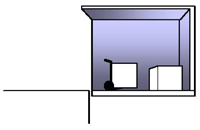
Most passenger elevator systems and standard freight elevators are designed as Class A, or “General Freight Loading”. The actual amount of a one-piece load being moved on to or off of the elevator cannot exceed 25% of the stated capacity of the elevator system. For example, although the capacity of the elevator may be 2,000 lbs (907 kg), the actual limit of a one-piece load is 500 lbs (226.75 kg). As well, the loading or unloading of the elevator is restricted to manual means or to a hand truck. In the event that a hand truck is used the weight of the equipment must be included as part of the 25% loading restriction.


Class B Loading

This class pertains to freight elevators that are intended for the transport of motor vehicles only, up to the stated capacity of the elevator system.


Class C Loading

NOTE: Class C loading is not permitted for accessibility lifts or for LULA elevators.

Class C1 Loading

This class allows industrial truck loading or unloading of the elevator system. The combined weight of the industrial truck and the load cannot exceed the stated capacity of the elevator. The loading device can remain on the elevator during operation.


Class C2 Loading

This class allows for the loading of the platform at 150% of the stated capacity of the elevator. In most cases, this allows for a one-piece load that equals the capacity of the elevator to be loaded with a forklift or motorized lift truck on to the platform of the elevator. The loading device must be removed prior to the operation of the elevator.


Class C3 Loading

This class allows for heavy concentration loading where the static load during loading and unloading does not exceed the rated load. The combined weight of the load and equipment must not exceed the stated capacity of the elevator system. In practice, Class C3 elevators are most often designated to support single piece loads equal to the capacity of the elevator.


Much of this information was taken from two web pages

www.delawareelevator.com & www.delta-elevator.com


If you have any questions or would like information from Colley Elevator you can go to www.colleyelevator.com, email Craigz@colleyelevator.com or call 630-766-7230.

Sunday, November 22, 2015

Escalator & Elevator safety tips & reminders

I recently read an article about a toddler in Dubai after getting her hand crushed in a high rise elevator.  Apparently a little girl stuck her hand between the elevator doors and the doors closed on her hand.   This is a reminder to pay attention when riding any conveyance and watch little ones. 


 Full article - http://gulfnews.com/xpress/dubai/news/girl-s-hand-crushed-in-elevator-accident-1.1613420

Last year we had a little person's hand get pinched by a door binder on the leading edge of the door as it was opening.  The door binder had been damaged by a mover and the building never had it repaired.  The door binder got damaged in between our visits and a little person got injured when their hands where by the door when it was opening.  What does this all mean?  Pay attention to your little people while riding elevators, it just takes a moment for something to happen. .  We should be riding in the middle of the elevator with hands away from any moving parts.  

Here are some tips to pay attention to when riding elevators.  

ELEVATOR
Don’t stop the doors from opening or closing
Never stick your hands or feet between the doors
Stand away from the doors
Take the stairs in case of fire
Locate the alarm button
Watch over children, never leave them unattended

ESCALATOR
Check the stairs direction
Never ride barefoot
Tie your shoes laces
Avoid carrying large bags
Stand in the middle of steps
Face forward, hold handrail
Watch out with loose clothing
Supervise children
Locate emergency buttons

Be mindful of these items when riding conveyances, while we do our best to provide safe transportation for all users the elevator industry needs your help to keep everyone safe!


Read more at the Elevator & Escalator safety foundation - http://www.eesf.org/safety/

The Elevator & Escalator safety foundation has a good amount of resources and does provide an education program for children, adults and college students.


If you have any questions or would like information from Colley Elevator you can go to www.colleyelevator.com, email Craigz@colleyelevator.com or call 630-766-7230.

Saturday, November 14, 2015

Elevator safety & freight elevators

Last week a 73 year old women fell down an freight elevator shaft in a two story building in Gaffney, South Carolina.  She told someone she was going to the 2nd floor and she opened a set of doors to access the freight elevator and she stepped in the hoist way and the elevator wasn’t there, the women died.  The link to the story is below.

http://www.wyff4.com/news/coroner-identified-volunteer-worker-killed-after-falling-down-elevator-shaft/36304554

The reason this resonated with me is recently we had a few buildings that have very old elevators.  One of the elevators we repaired the locks and they are currently working correctly the other building does not have the money to correct the safety issues with the elevator.  When I heard about this accident it hit home about why it is important to make sure we are making good decisions on our daily elevator inspections and we need to give building owners recommendations. 

Here is the predicament that older elevators have; they may be in buildings where there isn’t a lot of money to spend on the repair of the existing system and parts may not be available.   A complete freight elevator modernization is very expensive.

What do you do?  As an elevator contractor we need to give the building owner information for the repair of the system.  As a building owner they need to take these recommendations seriously and make the corrections.  If the building owner does not make the repairs to the elevator system you shut their elevator down and discontinue the service on the elevator system. 

How much is business worth?  I went to a building in 2014 and saw the elevators in the building.  The building wanted a repair on the elevator system.  After I saw the elevator system I sent a proposal to install a new elevator.  The building owner did not want to put a new elevator in.  A year later they called in an talked to another person at our company, before I knew it the person went to the building to look at the elevators and the building owner again "wanted a repair".  The building owner was calling anyone and everyone to come try and fix their elevator which needed to be replaced.  Again, we sent them a price for a new elevator system. Below you can see the elevators.

[Both elevators come down to the lowest landing, a person can easily go into the elevator pit, which is shallow, and the person would get crushed]

[This elevator machine served the building well for 80+ years but is in need of replacement]

As elevator professionals we are the people who can make the decisions on letting an elevator run or not, if it is not safe, shut it off.  Building owners, repairing the elevator system to be safe may be expensive but it is less than a serious injury or fatality at your building.  With this said, I am sending a quote out to a very old elevator that we shut off as they were running it with the gate open because a 2 speed manual horizontal gate is broken beyond simple repair. 


If you have any questions or would like information from Colley Elevator you can go to www.colleyelevator.com, email Craigz@colleyelevator.com or call 630-766-7230.