Monday, August 20, 2018

Traction freight elevator modernization


This traction freight elevator modernization project took an entire team to complete; from the  building owner design team, general contractor, electrician, fire recall company, security company, sales people, engineering, 4 different major equipment suppliers, field support, IUEC elevator constructors.  2 years in the making the project is finally completed.   Many thanks to everyone involved especially the installers!

The background on this elevator is that it was a Montgomery Elevator installed in 1940’s sometime and it had manual door operation with bi parting freight doors on the front and swing doors on the dock.  The specification called for making it an automatic freight car with new everything except the rails.

Controller – MCE
Machine, sling, safeties, HW equipment – Hollister Whitney
Cab & doors – EMS
Fixtures – Innovation

Machine – Holliser Whitney – A geared application was specified on this project, it was identified that not only would it be a tight fit to get this machine in, it also needed additional structural supports as the small foot print of the Montgomery machine had different reaction points and requirements.  Adding the weight of the new sling, platform and automatic gates required more steel to be installed in the elevator room.

[Old small foot print Montgomery machine]

[Old small foot print Montgomery machine]

[New gearless HWEC machine]

Controller – MCE was chosen to do this project because they used one less electrical device/box for incoming power.  The machine room is very small so space was at a premium.  Some of the other manufacturers qualified for this specification had and additional device/box.

[New MCE & EMS controllers]

Hoistway doors – EMS – We had some significant challenges on this project as the hoistway was fire block and there wasn’t a lot of material to work with to attach the new doors to.  The team working on the project did a beautiful job working with the existing conditions to make it work.

[Old swing doors on dock side - Interior]


[Old swing doors on dock side - Exterior]

[New dock side bi parting automatic freight doors]


[Typical manual freight doors at each landing]


[New automatic freight doors at each landing]

Cab – EMS – New automatic gates replaced the manual wood gates.

[Old cab with manual wood gates]

[New cab with automatic gates]

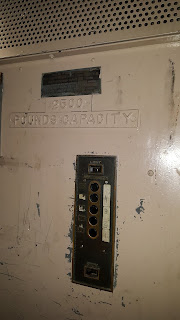
Fixtures – Innovation – New fixtures installed.  When pictures where taken we were still doing a final clean down of finger prints.
[Old Montgomery fixtures]

[New Innovation fixtures]

Pit work – Hollister Whitney – The pit was discovered during engineering to need to be re-poured and re-enforced.  The pit was shallow to begin with so every inch counted with the excavation and re-pour.

[Old pit]

[New pit]

Safeties – Hollister Whitney – New safeties installed.

[Old safeties]


[New safeties]

This was a challenging project for everyone involved and it turned out great.  From the initial hiccups of having the need for more design work after the initial specifications could not be met with the existing conditions to the completion there was over 40 people who worked on this project; building owner design team, general contractor, electrician, fire recall company, security company, sales people, engineering, 4 different major equipment suppliers, field support, IUEC elevator constructors. Hats off to our IUEC constructors who made each challenge a reality and Hollister Whitney’s engineering for having patience and knowledge to find structural solutions to make this a reality.  

As always feel free to contact us at www.colleyelevator.com, email Craigz@colleyelevator.com or call 630-766-7230.

Sunday, August 12, 2018

Anatomy of a hydraulic elevator – cantilever hydraulic elevator

The third in this series of anatomy of hydraulic elevators is the cantilever design.  This only is used when you have adjacent openings and don't want to use corner post rails.  Otherwise it is not a very desirable application, it has its place but should not be used for a heavily used environment or where concentric loads are being used. 


Elevator controller – Most hydraulic elevator controllers will have the same functionality with slight differences based on if it is a borehole, single stage holeless, multi stage holeless or MRL.  See a picture of a basic hydraulic elevator controller.  


Motor starter – The motor starter is allows the elevator’s pump motor to run in the up direction.  There are a few different options.  In new installations you should have a solid state starter installed.

Elevator door operator – The door operator is what opens and closes the elevator car doors.  When the car door opens and closes it has a clutch that will pick up hatch door equipment and allow it the open and close.  If an automatic passenger elevator is not at the floor it is nearly impossible for the hatch doors to open by themselves.


Elevator power unit – The elevator power unit has a pump, motor, valve, muffler and hydraulic fluid.  There are two main types of power units;

Dry hydraulic power unit – Typically the pump motor and valve are under the tank.  Appropriate application is for higher capacity elevators, higher travel and anything above 40HP or where you have hydraulic noise concerns.


Submersible power unit – The pump and motor are submerged in oil and the valve is on top of the tank or in the tank above the oil. Appropriate application is for lower capacity elevators, lower travel and anything 40HP and below where you do not have hydraulic noise concerns.


Hole less hydraulic cylinder – A holeless hydraulic elevator cylinder became popular after we realized that lower rise buildings can install these without underground condition risks.

            Positives
Installation of front, rear and adjacent openings w/o corner post rails
            Negatives
Pick on the elevator is not centered therefore loading wears on the components[piston & packing]

Take away – There is an application for the cantilever design; older buildings that have many different landings at different heights on different sides.  This application should only be used when absolutely necessary a borehole or dual holeless would be a more desireable application for 99% of installations. 

Credit - https://www.meiusa.com/ - Minnesota Elevator sells a full line of hydraulic elevator systems.

As always feel free to contact us at www.colleyelevator.com, email Craigz@colleyelevator.com or call 630-766-7230.

Sunday, August 5, 2018

Chicago Elevator Association Golf Outing – Quest for the Chicago Cup


[Colley's golfers - someone didn't get the memo on shirts]

Each year the Chicago Elevator Association [CEA], the longest running elevator association in America, has a golf outing. One of the high lights of the year next to the Holiday party!

[100% concentration]

This year was a shot gun start best ball for the quest for the Chicago Cup.  Colley sent their crack group of golfers to try and bring the cup to Bensenville, IL.  Well, we didn’t complete the mission as The Parts Specialist team scored a 60 on the 18 hole course.  

[Cut twice measure once]

On the course there are a lot of refreshments and booths scattered about.  The sponsors of the event provided a half-way house for lunch, cigars, give aways, beer carts, complimentary dinner drinks, prizes, etc.  Everywhere you turn there was something on the course.

[Looks good but not good enough to win the cup]

After the golfing is complete the 150 or so golfers and people attending only the dinner congregate in the banquet hall for fellowship and dinner.  Dinner was great!  Then comes the real deal!  The raffle!  I had never won much at this outing but decided it was time to double down on my efforts so I put down $40.00 to the 50/50 and the raffle for a signed sports jersey from Mark Grace, Frank Thomas, Bobby Hull or Dick Butkus.  It paid off, my ticket was the first to be called, I took the Butkus jersey.   About 80 raffle prizes came out and the 50/50, Mapin from Draka won the 50/50 the other 50% went to the EESF.  Mapin, did you give your 50/50 winnings back to the EESF?  Last year the guy you were sitting next to at dinner did, Mike Jennings[Virginia Controls].  Lets hear it for Mike!

\
[Dinner and raffle]

If you have never come, or haven’t been for a while, this is a good event and a lot of good people.  For all the travelers I didn’t get a chance to touch base with, I’ll see you in Atlantic City in 2 months!

[Back at the shop the wheels are still turning]

As always feel free to contact us at www.colleyelevator.com, email Craigz@colleyelevator.com or call 630-766-7230.

Sunday, July 29, 2018

Anatomy of a hydraulic elevator – Hole less hydraulic

We will have a series of posts for a few different elevator anatomies; Second will be a holeless hydraulic elevator.  Holeless hydraulic elevators thrive in lower rise applications when there is a single stage jack.  They manufacturer 2 and 3 stage holeless elevator as well for larger travel applications.  The cylinders are typically on the sides of the elevator next to the rails.


Elevator controller – Most hydraulic elevator controllers will have the same functionality with slight differences based on if it is a borehole, single stage holeless, multi stage holeless or MRL.  See a picture of a basic hydraulic elevator controller.  


Motor starter – The motor starter is allows the elevator’s pump motor to run in the up direction.  There are a few different options.  In new installations you should have a solid state starter installed.

Elevator door operator – The door operator is what opens and closes the elevator car doors.  When the car door opens and closes it has a clutch that will pick up hatch door equipment and allow it the open and close.  If an automatic passenger elevator is not at the floor it is nearly impossible for the hatch doors to open by themselves.


Elevator power unit – The elevator power unit has a pump, motor, valve, muffler and hydraulic fluid.  There are two main types of power units;

Dry hydraulic power unit – Typically the pump motor and valve are under the tank.  Appropriate application is for higher capacity elevators, higher travel and anything above 40HP or where you have hydraulic noise concerns.


Submersible power unit – The pump and motor are submerged in oil and the valve is on top of the tank or in the tank above the oil. Appropriate application is for lower capacity elevators, lower travel and anything 40HP and below where you do not have hydraulic noise concerns.


Hole less hydraulic cylinder – A holeless hydraulic elevator cylinder became popular after we realized that lower rise buildings can install these without underground condition risks.

            Positives
No underground condition risks – No well hole
                      Lower rise applications are easier to install – less expensive
                      No well hole driller - less risk and expense 
            Negatives
Limited in travel – Just because they sell them doesn’t mean it is a good idea                  
Multiple piston seals – more potential repairs
If you have a wet pit it will still rust the cylinder and require replacement of cylinders – If cylinder manufacturer is no longer around it creates challenges for replacement based on space available.

Take away – A holeless hydraulic elevator is a great option for some applications[lower rise, lower capacity].  When sizing an elevator make sure you are getting the correct application for your building’s needs.  Just because they make it doesn’t mean it is a good idea to have installed in your building long term. 

Credit - https://www.meiusa.com/ - Minnesota Elevator sells a full line of hydraulic elevator systems.

As always feel free to contact us at www.colleyelevator.com, email Craigz@colleyelevator.com or call 630-766-7230.

Sunday, July 22, 2018

Anatomy of a hydraulic elevator – Borehole elevator cylinder


We will have a series of posts for a few different elevator anatomies; first will be a borehole hydraulic elevator.  Hydraulic elevators thrive on installations that are 5 stories[40’] or less.  Anything above 40’ you run into a the graph of costs for installation exceeding a traction elevator.  The picture below shows a hydraulic elevator with a bore hole application.


Elevator controller – Most hydraulic elevator controllers will have the same functionality with slight differences based on if it is a borehole, single stage holeless, multi stage holeless or MRL.  See a picture of a basic hydraulic elevator controller.

[Brand new MCE 2000 hydraulic controller]

Motor starter – The motor starter is allows the elevator’s pump motor to run in the up direction.  There are a few different options.  In new installations you should have a solid state starter installed.  The motor starter is in the bottom right hand corner of the picture above. 

Elevator door operator – The door operator is what opens and closes the elevator car doors.  When the car door opens and closes it has a clutch that will pick up hatch door equipment and allow it the open and close.  If an automatic passenger elevator is not at the floor it is nearly impossible for the hatch doors to open by themselves.

[New GAL MOVFR II door operator]

Elevator power unit – The elevator power unit has a pump, motor, valve, muffler and hydraulic fluid.  There are two main types of power units;

Dry hydraulic power unit – Typically the pump motor and valve are under the tank.  Appropriate application is for higher capacity elevators, higher travel and anything above 40HP or where you have hydraulic noise concerns.


Submersible power unit – The pump and motor are submerged in oil and the valve is on top of the tank or in the tank above the oil. Appropriate application is for lower capacity elevators, lower travel and anything 40HP and below where you do not have hydraulic noise concerns.


Bore hole cylinder – A bore hole cylinder is the most basic hydraulic elevator on the market, and most popular.  The simplicity of the design is functional, reliable and easy for minor repair.  The cylinder goes in the ground as far as it goes up.

[Typical bore hole cylinder application]

            Positives
One hydraulic seal to maintain
Ease of installation and maintenance
Reliability

            Negatives
                        Potential for environmental issues to call cylinder to fail on older systems
                                    Newer cylinders should have PVC protection
Well drillers could run into issues with challenging drilling conditions during installation
                                    Water
                                    Rock
                                    Sand
                        Cylinder replacement can be expensive and full of unknowns

Take away - This is some information on a borehole hydraulic elevator with typical parts and components.  When choosing an elevator application it is best to consider how it is being used, environment, expectations, frequency of use, travel, what is being moved, etc.  At times we only consider design and price which can create an issue of how well the elevator services the building in the long run.

Credit - https://www.meiusa.com/ - we buy power units and elevator packages from MEI

As always feel free to contact us at www.colleyelevator.com, email Craigz@colleyelevator.com or call 630-766-7230.

Sunday, July 8, 2018

Are MRL [Machine Room Less] elevators dangerous?


Over the last 9 or so weeks we have had 3 fatalities of elevator constructors.  2 of which occurred directly based on the design of the MRL[Machine Room Less] elevator.  We recently went to a OSHA meeting that we discussed some of these accidents.

I was at a portfolio building account we have who just had a MRL installed which we will be maintaining.  Perhaps I am just not educated enough on these new pieces of equipment but from what I see and what I hear they do not appear to be a good idea.

[Elevator's valve and pump and motor in elevator pit]

[What is above you when you are working on it - the elevator]

[Typical elevator's have a machine room where the controller and mainline disconnect would be located.  This elevator has it in the door frame]

[Controller slides out of the hoistway door frame - yes the elevator door is right behind it]

[Elevator's disconnect - in this case the lock was broken and was not easy to get into]

We get many opportunities to bid on MRLs for maintenance.  We pass on most of them because we are not to the point of comfort yet with the layout as well as some of the proprietary technology.  We do have a few on contract mostly because it is a portfolio account where we do other conveyances for the building owner.

Positive – These elevators are a dream for design teams to put in their drawings because they eliminate formal machine rooms

Negative – These elevators are nightmares to work on because they eliminate formal machine rooms and have several maintenance challenges and potentially increase worker hazard while servicing or maintaining them.  Again, maybe I am not educated enough on these newer pieces of equipment., they just do not seem like a good idea.

In my opinion the trend of installing the MRL is a tragic mistake that is seeing building design in front of worker safety.  I also have not seen a MRL that is built as well as a traditional machine room elevator system.  Everything is smaller and less robust.  This means it will have to be replaced sooner than a traditional elevator with a machine room.  But, they save space and they are usually cheaper to install.  PLEASE NOTE: NOT CHEAPER TO MAINTAIN.

As always feel free to contact us at www.colleyelevator.com, email Craigz@colleyelevator.com or call 630-766-7230.

Sunday, July 1, 2018

Hot weather and elevator problems


As the Chicago area weather has been very hot the last few days our overtime guys have been chasing calls from hot and humid weather.  This is a repost from August of 2017.  

This summer we have seen more frequent failure of solid state boards and equipment that has been exposed to extreme heat and extreme cold.  Building owners frequently ask “why is this occurring”.   I always like to give some research and background when explaining to building owners so they can be better educated and came across a great article which I have taken some of the high points.  When reading this be aware that most issues with machine room environments will result in a shut down or needing a replacement board, but, incorrect machine temperatures can also cause malfunctions which could result in an elevator operating in an unsafe condition.

The subject of the operation of an elevator in an elevated high ambient machine room temperature is one of concern of elevator manufacturers, code writes, enforcing authorities, building owners, and operators, elevator consultants and fire safety personnel.  Today’s solid-state design elevator control systems are able to maintain rated performance over a wide range of normal design operating temperature, but are vulnerable to elevated temperature conditions.

NEII Vertical Transportation Standard calls for machine room/or machinery spaced temperature to be between 55 and 80 degrees Fahrenheit

NEMA has established a maximum temperature limit of 104 degrees Fahrenheit.

National Electrical Code[NEC] has published 86 degrees Fahrenheit as the standard ambient for conductor ampacity ratings.

Computer manufacturers recommend an ambient temperature of 60 to 90 degrees Fahrenheit.

The effects on solid state components due to temperature may be classified in two areas; operating[reliability] and failure[life].  The manufacturers recommendation for ambient temperature will allow the devices to operate in a repeatable and predictable fashion.  Temperatures above or below the recommended temperature will decrease the life of the solid-state system.

Please note - Elevator controller temperatures are 10 to 15 degrees warmer inside the controller with the cover on. If an elevator machine room is 105 degrees the temperature when you open the door, the controller could be over 120 degrees.

Causes of machine room over temperature
1.    Failure of machine room ventilation or no ventilation
2.    Failure of cabinet ventilation system – air condition or fan
3.    Increase in the elevator duty cycle beyond design criteria
4.    Sustained operation at low AC input levels

The recommendation of machine room temperature control come from a few different areas
1.    Normal temperature in room – In Chicago we have hot summers and cold winters
2.    Amount of heat released from the elevator equipment in the machine room – depends on the equipment you have and amount of traffic in the building
3.    Amount of ventilation and/or air conditioning/heating provided in machine room.

Take away – Be aware of the machine room environment and make preparations i.e. air conditioning[best case] or ventilation in summer and heating in the winter.

Reference – “High temperature operation of elevators” by Nick Marchitto


As always feel free to contact us at www.colleyelevator.com, email Craigz@colleyelevator.com or call 630-766-7230.