Sunday, November 24, 2019

State of Illinois Elevator Braille ADA requirements Inspectors enforcing NOW!

A newer mandate is being enforced in the State of Illinois requiring all elevators to have Braille on elevator car stations and hoistway entrances.  This requirement has been on the books for some time but never enforced until a clarification from the State of Illinois Fire Marshall. 

Rule - State of Illinois ADA mandate 410 ILCS 30/1 from Ch. 111 ½, par. 3901 & 3902 - See below. 

What are elevator inspectors doing?  Some are failing elevators now, some are giving buildings until next inspection to comply.

What is Colley Elevator doing about it?  We are going to each building and collecting information on each elevator and will be sending out proposals for the installation of Braille.

Car stations – Each usable[to general public] car station device will require ADA compliant Braille.


Hoistway entrances – Each hoistway entrances will require to have Braille on each side of the door frame.


Advice to building owners & property managers – Get your information from your elevator contractor now and have it installed as soon as possible.

If you have any questions or would like additional information feel free to contact me at CraigZ@colleyelevator.com or 630-766-7230 ext. 107.

Also check us out on Instagram @Colleyelevator see what we have been up to.

Saturday, November 16, 2019

Elevator New Construction – Elk Grove Village VFW – Elk Grove Village, IL


We got a call from our Local Union office asking if we would be interested in helping the Elk Grove Village, IL VFW get an elevator installed.  I had so happened to have been to this building before so I knew there was accessibility challenges.  We of course said yes and began the long process of planning and installing an elevator for the Vets. I have a deep respect for all who choose to serve our country and wanted to give something back.  The reason I'm in the elevator business is because my father fell into the elevator business after going to school on the GI bill.  Colley Elevator donated over $40,000.00 to the elevator installation.

We had a few general contractors, a few electricians, a lot of cooks in the kitchen but at the end of the day and 2 years after our initial engagement with the VFW we turned over the elevator for usage.  All of the Veterans that run the building where wonderful to work with and I am very happy we finally delivered an elevator to them.

Package provider – Canton Elevator
Controller – Motion Control Engineering
Fixtures - GAL
Power unit – Canton Elevator w/Maxton UC4 Valve
Door operators – GAL MOFVR

Outside of building – It is always amazing to see existing buildings before and after construction.

[Pre construction meeting]

[Building in process]


[Building in process]

[Completion]

Elevator machine room – This elevator started out as a hydraulic MRL and was changed to a typical machine room hydraulic elevator.  We got a chance to use the bullet proof MCE Motion 2000 control system.

[Machine room GC gave us to work with]

[New MCE 2000 and Canton Power unit]

[Bullet proof MCE Motion 2000 controller]

[Maxton UC4 valve in power unit]


Hall and car fixtures – Nothing fancy here, front and rear openings with GAL fixtures.

[Elevator lobby]


[Return & GAL Fixtures]

[GAL elevator car station]

Car top – This is a holeless hydraulic with GAL MOVFR door operators.

[Front and rear openings with the MOVFR]

Package provider – Canton Elevator was great to work with on this project with the bumps, changes and whatever we needed. They made it easy.

Thank you to all the veterans who have served our country!  We need to support you when you come home!

If you have any questions or would like additional information feel free to contact me at CraigZ@colleyelevator.com or 630-766-7230 ext. 107.

Also check us out on Instagram @Colleyelevator see what we have been up to.

Sunday, November 10, 2019

The Elevator Maintenance Trinity – Maintenance required


Back in 2016 I wrote a piece on something I call the Elevator Maintenance Trinity; Companies, Mechanics and Building owners are responsible for making sure their elevators are maintained properly.  This last week I was at a few buildings doing engineering on modernization projects we are doing which reminded me that we all need a reminder from time to time that pride and responsibility are still a job requirement for all three; contractors, mechanics and building owners. 

[How many items on this car top can you find that are wrong?]

Contractors – We are the most important part of the equation.  Elevator contractors need to give elevator mechanics time to do elevator maintenance. Elevator contracts need to educate building owners why elevator maintenance is important.  We live in a faster time where short term goals are more important than long term relationships.  Monthly maintenance is being replaced with quarterly maintenance.  Reasonable route sizes are being replaced with super routes.  6 to 15 minutes stops are being assigned to some OEM companies.  Contractors need to look at each elevators environment, age and traffic pattern to encourage building owners to have the correct amount of maintenance visits/time needed.

[It took a few years to get this build up on the ropes]

Mechanics – The elevator mechanic is key to this equation as well, you are the execution.  An elevator mechanic needs to have the motivation to oil, grease, clean, replace parts as needed.  We need to take pride in our jobs.  At times some of us get hung up on “just another elevator”, “this is good enough for this visit”, “I’m too smart or have too much experience to clean” or “I have too much to do” and forget that these elevators we maintain are for people who cannot use stairs, who need to get to doctors’ appointments, have handicap visitors who look forward to seeing their friends/families in buildings, etc.  Our work is very personal to a lot of elevator users who lose their independence and dignity when we are not doing our jobs.  If you get the time we need to execute so the contractor can sell the frequency/hours that is required to properly keep the elevator in good condition.

[Come on man[or woman]!]

Building owners – The building owners/managers are the ones who are paying the contractors for doing the work.  They should pay a fair price for a service that will allow their elevator to service the building in a safe and reliable manner.  The cheapest price is not always the answer, you do get what you pay for.  A building owner should find an elevator contractor who can explain to them why the specific maintenance plan is a good fit for their elevator system and explain what they are getting for the price.  If the building's elevator equipment is past its life expectancy, it needs to be replaced.  It is your responsibility to engage your contractor on modernization proposals and educate yourself so you can budget appropriately.  Getting proposals for 10+ years for the same scope of work and saying "the building doesn't have it in their budget this year" is not acceptable.

All three entities need to be working in unison to achieve the ultimate goal of safe, reliable elevator service that allows existing equipment to last a long time.  In our industry we have great contractors, great mechanics and great building owners.  We also have not so great contractors, not so great mechanics and very price sensitive building owners.  I am proud to be in the elevator industry and when I see some of this behavior going on it is disappointing.  We can do better!  Contractors need to give mechanics the time and resources, mechanics need to execute and building owners need to pay for a reasonable maintenance plan and modernize their equipment within a reasonable time line.

This is the same story I was beating the drum on in 2016. If you want to take a look at the 2016 Elevator World Article a link is below.  The photos are from a great building owner who is getting poor service from the company they have been with for many many years and are hiring a new company to do their modernization.


If you have any questions or would like additional information feel free to contact me at CraigZ@colleyelevator.com or 630-766-7230 ext. 107.

Also check us out on Instagram @Colleyelevator see what we have been up to.

Saturday, November 2, 2019

1929 Haughton Traction Elevator slated for 3rd or 4th modernization – Chicago, IL


Since I have been working at Colley Elevator we have taken care of a Mansion on the near Northside of Chicago.  One of our old partners in the business said he modernized the elevator before he came over to Colley in the 1979.  After hearing more stories it appears this elevator has been modernized 2 or 3 times prior to the scheduled modernization this next year.   I was told the elevator started as a dumbwaiter back when the building was built in 1929.  This is just some neat Chicago elevator history when you start digging around during engineering. 

Controller – The most recently controller is a CJ Anderson which was installed in 1979 by Gallaher & Speck.


Door equipment – GAL MOD with double clutches with center opening 2 speed doors


Machine – I’m not sure when this machine was installed, looks like 1950’s.


Car top – Old crusty elevator car top ready for a deep clean during modernization


Under car - Nice old wind up safeties 


Outstanding questions – When doing modernization on elevators this age we have a lot of questions that need to get ironed out before ordering equipment.


Capacity – Data tag says 1500lbs, car station says 1000lbs
Car speed – Data tag says 200fpm, the elevator doesn’t even go 100fpm
Car weight – 3100lbs?  Still from 1929?

If you have any questions or would like additional information feel free to contact me at CraigZ@colleyelevator.com or 630-766-7230 ext. 107.

Also check us out on Instagram @Colleyelevator see what we have been up to.

Saturday, October 26, 2019

Hydraulic elevator control modernization – Mt. Prospect, IL


We had the opportunity to work with a general contractor and building owner on the modernization of 4 hydraulic Westinghouse elevators from the mid 1970s.  The process started around 2 years ago when we got a request for a budget, then a firm quote, then the formal quote, then contract negotiations, engineering, submittals, ordering material and finally job site mobilization and installation.


Controller – Smartrise Engineering
Fixtures – Innovation Industries
Door equipment – GAL Manufacturing 
Power units – MEI/Minnesota Elevator
Roller guides – Elsco
Cylinders – EECO/Elevator Equipment Corporation 

Machine room layout – While the new equipment is wonderful, the area the new machine room layout gives the elevator mechanic is a game changer.  Since we have so much room the building decided to put Milton from Office Space's temporary work station in the elevator machine room.  I let the building know that the work station had to go as it cannot be in the elevator machine room, even if his stapler is in there. 


Old machine room layout

New machine room layout

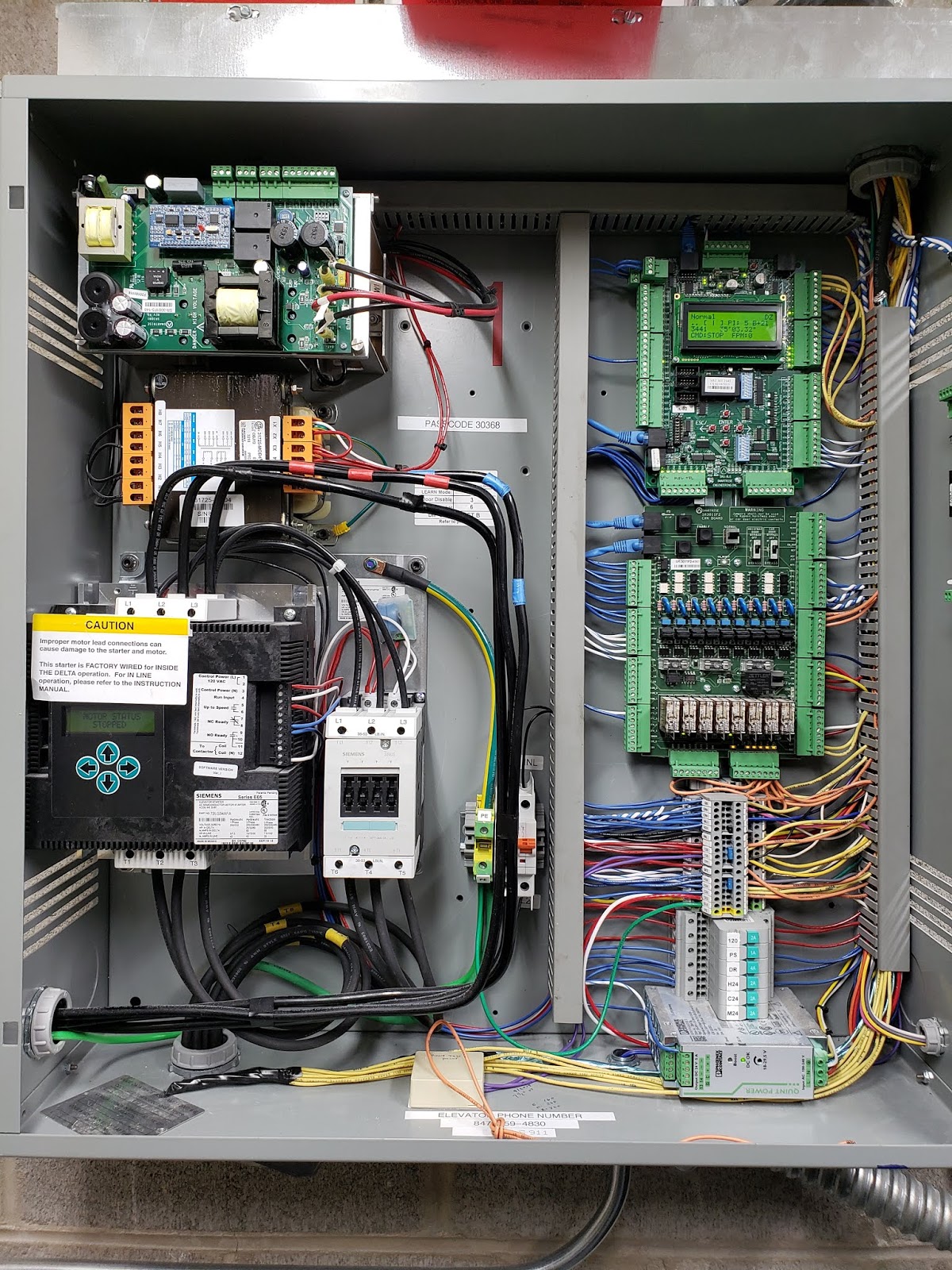
Controllers – The existing controllers where Westinghouse relay logic from the original construction of the building. We replaced them with Smartrise Engineering’s hydraulic elevator control system.

Old Westinghouse hydraulic control system

New Smartrise Engineering control system

Fixtures – The existing fixtures where standard Westinghouse.  The new replacement fixtures are from Innovation Industries.


Old Westinhouse car station

New Innovation Industries car station

Old main lobby hall station - Multi light position indicators

New main lobby hall station - Digital position indicators


Power units – The old power units where old Westinghouse dry units with UV7 valves on them.  The replacement power units where manufactured by Minnesota Elevator and utilizes Maxton UC4 valves.

Old EECO valve

New Maxton Valve

Cylinders – All 4 elevators had the original cylinders from DL Martin/Westinghouse.  The owner wanted to remove them so there would be piece of mind and no potential for cylinder failure in the future. 

Old Westinghouse/DL Martin cylinder

New EECO elevator cylinder 

Take away – From start to finish this was team effort.  The GC was great, the building owner was patient and understanding throughout the whole project. Our project team was awesome!  Without the sales guy there is no project, without the elevator installation personnel there is no project, without the engineer there is no project, without the project manager things don’t go as smooth, without the delivery/prep team there are big time line challenges, without the office support staff to do billing and certified payroll the company doesn’t get paid.  Execution on all parts of this was tremendous and I’m lucky to have been 1 of 15 people from Colley Elevator to have been part of this project!  Thank you to everyone involved!  

If you have any questions or would like additional information feel free to contact me at CraigZ@colleyelevator.com or 630-766-7230 ext. 107.

Also check us out on Instagram @Colleyelevator see what we have been up to.

Saturday, October 19, 2019

What should not be in an elevator machine room


We get the opportunity to see all sorts of buildings with all sorts of great things and not so great things.   This is  a quick one about what should not be in an elevator machine room.  As a building owner, manager, condo board or someone else who can help us, please do!  The better our machine room environment, the better we can maintain and service your elevator.

Water – We don’t really care for water in the elevator machine room, mainly because we could get electrocuted with the high voltage that is connected to the elevator system.  This machine room is recessed under the building and has a tendency to get water in it every now and then when the water table rises.  The building was building in the mid 1960’s.


Sewage – Water is one thing but sewage, no thank you.  This sewage was in a machine room we are modernizing the elevators and their pipes backed up, yes, that is soiled toilet paper. That 2 x 4 was for a person  to stand on during a OT call right after this happened.


Oil buckets/drums – Yes, elevator hydraulic oil buckets are elevator supplies, when we start seeing more then 1 or 2 empty oil buckets in a machine room we start asking a lot of questions.  This machine room has 14 empty buckets and a 55 gallon drum..


Video monitoring equipment – Buildings are always in a space crunch and one common element that is being added to more and more buildings is video monitoring.  It often ends up in the elevator room.  It is within the elevator inspectors rights to tell you to move the video equipment.


Stuff – The elevator machine room is a great place to put “stuff”.  Please find a new spot to put your “stuff” we need to get to the elevator equipment.


What should be in an elevator machine room?  Only elevator equipment and elevator supplies.

If you have any questions or would like additional information feel free to contact me at CraigZ@colleyelevator.com or 630-766-7230 ext. 107.

Also check us out on Instagram @Colleyelevator see what we have been up to.

Sunday, October 13, 2019

When is it time to change your elevator’s dry hydraulic power unit?


We recently took over a group of buildings that had a lot of aging ESCO dry power units that had been passed over for replacement over the years.  The other elevator equipment had been modernized over the last 15 years; Controllers, fixtures, door operators.  The power units had been forgotten and patched with some new valves.  So when is it time to replace your power unit?  And, how important is your power unit?

What does my power unit do?  Your hydraulic power unit has a motor, pump, valve and hydraulic fluid in it.  The power unit pumps and regulates the oil floor to the piston which allows the car to level into the floor correctly.


When is it time to replace your power unit?  This is a great question.  Every building will be different.  Some building’s power units can last 50 years, some buildings last 10-15. The major wear point on a hydraulic power unit is the control valve. Maxton and EECO the two major valve manufacturers suggest replacing your valve every 10-15 years.  Here are a few variables that determine how long your power unit will last.

Usage – Busier buildings will most likely need a valve replacement sooner than a sleepy building. 

Machine room environment – a temperature controlled environment that keeps the oil cool will allow for a longer life of your control valve

Oil maintenance – If you keep your oil clean, have it filtered, or have it replaced your valve will work longer.

Valve maintenance – When required, have the valve seals been replace?


If you take a closer look at the picture above you will see two old ESCO power units, you will also see fans pointed at the controllers, you will also see a dirty machine room.  This elevator room is very warm/hot coupled with age and a less than ideal machine room environment equals poor longevity of valves.  

At some buildings power units are left as the last item to be modernized.  We always encourage buildings to replace their valves on a regular basis when there are signs of wear so we can have safe and reliable running elevators.  While the power unit is typically one of the more resilient components it is also a component that the building needs to listen to their elevator company on to make sure replacement and service items are addressed quickly.

What does a new submersible power unit look like?  The great thing about a new submersible power unit is that everything is in the tank so there are no more leaks to worry about.  A submersible power unit will work for 95% of all hydraulic elevators, be aware that depending on usage, travel, capacity you may need to look into retaining a dry unit.

[New pump motor and valve are in the black box, no more leaks]

[Nice new Maxton valve and air mufler]

If you have any questions or would like additional information feel free to contact me at CraigZ@colleyelevator.com or 630-766-7230 ext. 107.

Also check us out on Instagram @Colleyelevator see what we have been up to.