Sunday, November 26, 2017

When is it time to plan an elevator modernization?

This is always a question we get from building owners who have older equipment.  When should we plan for a modernization?  This is a great question that hopefully you as a building owner have been thinking over long before equipment reliability has forced you to begin thinking of this.

 [This is a ESCO Elevator controller that runs well for its age]

 [Born in 1969 - 48 years old]


Building’s expectations of elevator equipment – If a building has an expectation that the elevator should run flawlessly then equipment should be replaced after 15-20 years. Typically you begin to see a pattern with good run time becoming less and less between failures.  How elastic is the building with shut downs and nuisance problems.  If not very elastic, change the equipment before you start having issues.

 [Valve was replaced but original pump and motor]

Building’s environment – Some buildings are easy on their elevator equipment some buildings are hard on the equipment.  If the building is exposed to the elements, heat, cold, rain, snow, etc this would also shorten the life of the equipment.

What type of equipment is currently installed – This is a lot of great elevator equipment out there that can run for a very long time 40+ years.  There is also some equipment out there that runs for 15-20 years and begins to develop issues.   In our universe a 40 year old ESCO relay based controller is a better controller than a 20 year old Montgomery Miprom of Schindler Westinghouse MPH II.  One of the reasons 40 year old equipment may last longer is because it has less features such as firemans’ service and other safety items that require more complicated circuitry.  Also, solid state boards are not as reliable or as easy to replace as high duty cycle relays used for older elevator systems.

 [This elevator is so old that the original inhabitants of the elevator hoistway recorded the history of the elevator on the walls]

Who is your elevator maintenance company/mechanic – This is also very important.  If you have a company that specializes in your equipment you may get longer life out of the elevator.  Make sure the elevator company you hire is a good fit for the equipment.   I.E. Otis Elevator may not be a good fit to work on ERM controllers, unless they have someone who is familiar with the ERM product.  In the same respect Colley Elevator would not be good for a Gold Flight Schindler/Haughton elevator.  “Old Joe who has taken care of our elevators for the last 20 years is going to retire”.  Find out who is going to be replacing Old Joe and if this person knows your type of elevator systems.  All elevator mechanics are not the same and they all have different strengths and knowledge of different types of equipment.

Can the building afford it – This is probably the biggest part of the equation. Elevator modernization is expensive and comes with other items the building needs to address I.E. Fire systems and non-elevator electrical work.  A good practice would be to get preliminary numbers from you elevator maintenance company so you know what you are looking at as far as cost goes. We talk to reserve study companies on a regular basis who charge for this service, your elevator company would most likely do it for free. 

 [This door operator has been opening and closing for the building for 48 years]

Is the elevator code going to mandate a change – The elevator code could mandate a building to replace their equipment to comply with a new requirement i.e. Fireman’s automatic recall or in Chicago FEO phase II compliance.  Find out what is on the horizon for your jurisdiction.  A good source is your elevator maintenance company or an elevator consultant.  If you hire an elevator consultant, make sure it is a experienced reputable one.

Take away – Be aware of your current elevator equipment and have a solid plan of when you should be thinking of replacing it.  If you have the funding and the equipment is running well you can always punt a year.  On the other hand, if you are not financially prepared and you need to do it now, it is hard to collect the amount of money needed to complete a modernization.  Be as prepared as you can.

The pictures are from a modernization take off we did recently for a building that will be changing their elevator equipment shortly after years and years of nuisance issues and shut downs.


As always feel free to contact us at www.colleyelevator.com, email Craigz@colleyelevator.com or call 630-766-7230.

Sunday, November 19, 2017

Chicago elevator maintenance traction elevator – dormant buildings

I was scrolling through old emails cleaning up old emails and found these pictures of a traction elevator from a building that was dormant, owned but not occupied.  We previously had the maintenance contract, building owners moved out, the building was dormant for many months until a sale was finalized.  At some time during this period one of the elevators stopped working. 


While the outcome is the same if this was caught before it was a balled-up mess, the resolution would be a lot cleaner if it was identified earlier or perhaps it could have been prevented.  In my opinion one of the worse things for an elevators is having it not be exercised on a regular basis.

Take away – Even dormant buildings require elevator maintenance.  The hard part of this is that a dormant building has no revenue associated with it and there is an expense of paying an elevator mechanic to inspect the elevators.  An elevator mechanic may have caught this earlier or could have cared for the elevator so this would not have occurred.  Now the cables need to be replaced.


As always feel free to contact us at www.colleyelevator.com, email Craigz@colleyelevator.com or call 630-766-7230.

Sunday, November 12, 2017

Elevator pits hall of fame – Volume #2

Here is the 2nd edition of some of our better pit pictures, no great pits in this one.


This one is from 2015. I believe it was from a postal facility where they wanted me to measure for a new cylinder.  I got some push back when I told them I wouldn’t go in the pit until it was drained and cleaned out.  I had to explain to the PM and building owner why I wouldn't get in this pit and send pictures. 


I got a call for a building that is relatively close.  This was a strange instance where we had some people on vacation, doing testing and on calls.  The call was the fire alarm in the pit was going off and they needed someone there now.  I took a ride over and nothing seemed out of the ordinary until I found this.  They had more than a fire alarm issue.  Worked out well, elevator guy met the plumber, then the elevator guy met the alarm guy. 


This one was from 2015, this is a wild one where the water is very clear compared some of the pits we see water in.  I want to say this was a bank up in the northshore where we had to change the pit equipment in after this occurred more than a few times.  I don’t believe the oil ever go contaminated.  Hard to believe right?


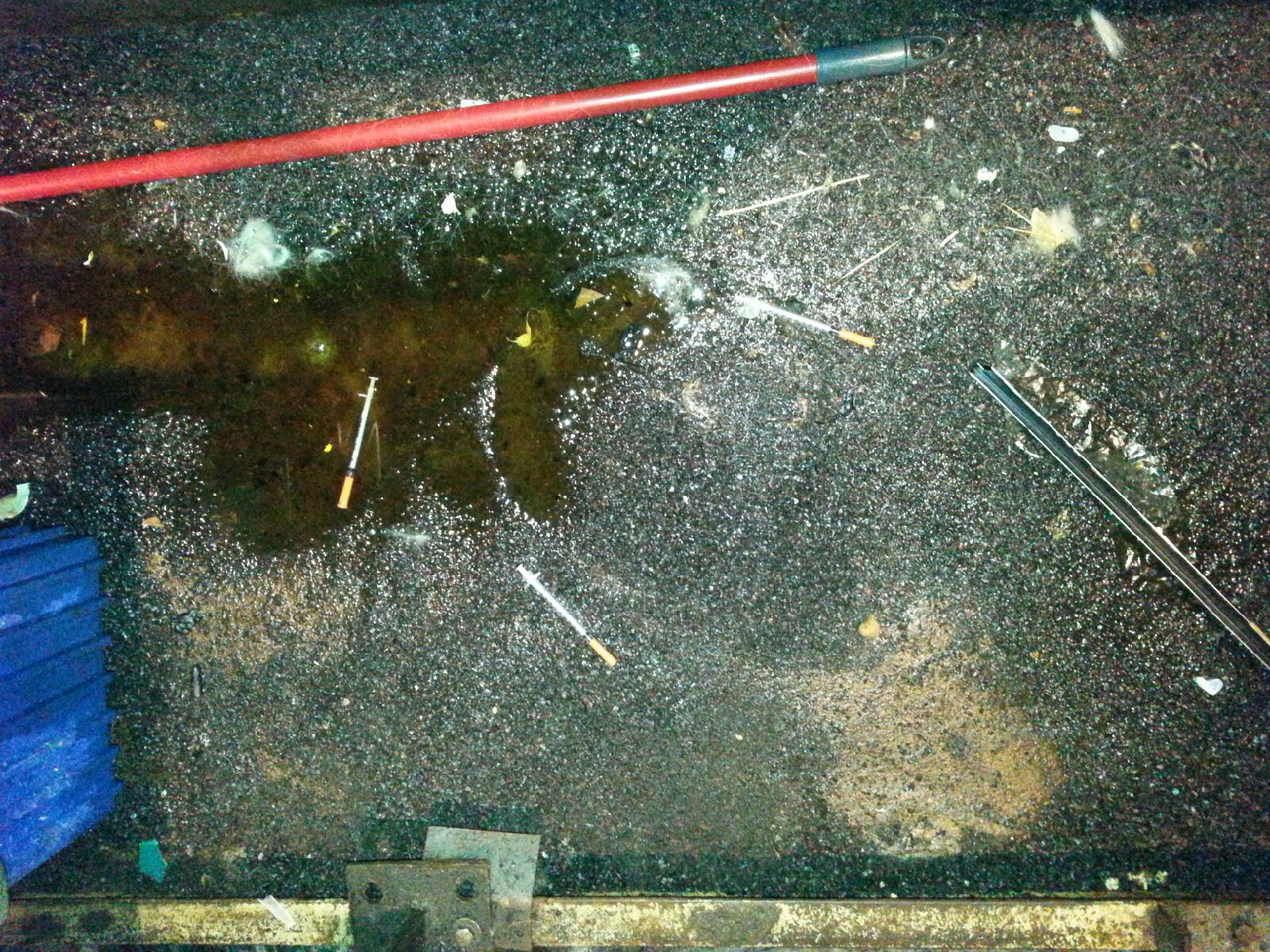
This was a eye opener when I was measuring for pit ladders in Skokie, IL I stumbled upon this.  We ended up responsibly disposing of the syringes.  I think I was at a bid walk though at a Village Hall somewhere and they where handing out syringe disposal containers.   If you are not comfortable handling these, do not handle them, call your supervisor and ask what you should do or have your supervisor handle it.  These could be a social user or medical user, can’t tell, you don’t want to find out.  This wasn’t our elevator on maintenance, it was a nice hotel which made it even more surprising that these popped up.  


The elevator pit you see is from when our Northshore/Northside got hammered with something like 12-18 inches of rain in 36 hours in July.  There is a controller from 1964 and it runs like an elevator in a haunted house.  I can think of a better use for the water rather than going in the pit. No oil contamination.


The next two pictures are also from July.  The building’s basement got flooded pretty bad.  No oil contamination during this rain.  The wild thing is that we got a good amount of rain recently and the building flooded again.  The amount of rain was significantly less but plunger must have taken on a few gallons of water.  We put new oil in and are using the a filtration device which removes water and it should do the trick.  It will take 30-60 days to get all the water out with the device.  If you are interested in how this works, email me.


As always feel free to contact us at www.colleyelevator.com, email Craigz@colleyelevator.com or call 630-766-7230.

Sunday, November 5, 2017

Elevator pits Hall of Fame - Volume #1

Over the years you accumulate a lot of pictures of good things, bad things, cool things, etc.  I added a new picture to a shared folder we have in our office called “Hall of Fame”.  What typically ended up in the hall of fame is train wrecks, but some good things pop in there from time to time.  I have been doing the blog since May 2014 and it is hard to come up with new and good content every week so when I saw the oval PVC it reminded me of all the gems we have in our folder.


1st picture is a picture from a small portfolio of elevators where an OEM had been completing maintenance for many years.  Over the years they just pulled back and pulled back maintenance and only went there a few times a year for a few minutes. Differed maintenance or no maintenance?  We went back a year later before we took over the account and the pit still looked like this


2nd picture is a duplex elevator that has a water problem. This is a large amount of water if you add up the square footage and converted it to gallons.  Look where the sump is.


 3rd picture is a cylinder we are removing right now.  We found that this PVC is oval.  There was no leak in the cylinder, the building was told there was a leak.  The issue here was the piston was scored from being installed crooked so by the time we go there it could not be salvaged.  There was also a big knock on this car and the car next to it.  I would imagine the company who used this PVC had an issue with it becoming oval so it became difficult to plumb the cylinder.  This PVC has no markings what material it is, just black PVC.  It weighs about 60% of what schedule 40 PVC weighs, much easier to move around but apparently there is a downside to it.  This is from an OEM installation.  This could also go into a "bad/interesting cylinder hole replacement" heading.


4th picture is an elevator that was out of service that the building owner wanted to see what they could do.  We passed.


5th picture is what I am always impressed with.  An elevator mechanic and company who takes pride in their jobs.  This is from an independent company in the Chicago area, I would like to take credit for this but it was another company. 

As always feel free to contact us at www.colleyelevator.com, email Craigz@colleyelevator.com or call 630-766-7230.

Sunday, October 29, 2017

Elevator modernization - Utilizing higher voltage

Once in a while we see a building upgrade their power from 208/230 to 480 and they install a transformer in the elevator room to knock the power down.  During a modernization is the perfect time to order 480vac equipment and get rid of the transformer.

Benefits of higher voltage – The benefit is that is uses lower amperage, what you pay for on your power bill is the amperage usage.  You can use smaller more efficient motors and smaller motor starters.  See the table below

Voltage
HP
Amperage
230
30
76
480
30
38

In our case the building went to 480vac during a reconstruction project and left the elevator to be modernized at a later date.


We will be modernizing the elevator with 480VAC equipment and this will allow us to remove the transformer, put the hydraulic unit on the back wall and have lots of space for our elevator controller and power freight controller which currently are stacked on top of each other making it interesting to work on.  

[get your ladder or stool to work on the freight controller or perhaps it is that i'm short I cannot reach it]

The key here is communication and planning with the building owner.  We have a great building owner who is working with us through this project. 

Also - Chicago Elevator Association meeting this Thursday, November 2nd at The Clubhouse - Oak Brook, IL 6:30pm.  

As always feel free to contact us at www.colleyelevator.com, email Craigz@colleyelevator.com or call 630-766-7230.

Sunday, October 22, 2017

The “Green” elevator installation/modernization/replacement

I get phone calls on regular basis from builders/future owners of buildings asking why our new elevators are more expensive then one of the intergalactic OEM’s.  One of the main reasons I give is that we are supplying you with a 30-40 year elevator and the OEMs are not, they are giving you a 15-20 year elevator.  This article published by Elevator World has some great information on the sales pitch of a “green” elevator.  I believe the intent of this article was to promote hydraulic elevators, what I took out of this is the longevity and environmental impact of all elevator systems dependent on how robust the elevators are built.

The issue with the “green” elevator is that it lasts 15-20 years and while it does have an energy savings during its life time in service to the building, it does not over the full manufacturing to disposal period.  The data attached is indicating that by far the environmental impact that is felt is during manufacturing and disposal.  There is 10x more environmental impact during manufacturing then during the usage of the lifetime of the elevator.   

 Source - Graph is from Elevator World Article, see below for link.

Lets do quick math – assume that a Minnesota Elevator, Canton or Hollister Whitney’s elevator may last 30-40 years and the Intergalactic OEM will be a 15-20 year.  These are general assumptions for this analysis.

MEI/Canton/HWEC – perhaps the manufacturing impact would be more based on the equipment being heavier duty - this is a quick example of how the numbers would work.  This includes 1 manufacturing impact and 2 operational impacts because we are going with a 15-20 year assumed life, this equipment may get 2 “life times” out of it.  You would also assume that the operational impact would be more because the equipment is typically heavier duty and more robust.  
  
Hydro
Traction
Manufacturing[x1]

549
701
Operation[x2]

45
66
Disposal[x1]

286
343
Overall environmental impact
880
1110


Intergalactic OEM – This includes 2 manufacturing impacts because life of these elevators are assumed to be 15-20 years.  This also includes 2 disposal impacts because 2 sets of equipment will need to be disposed of during 30-40 years.

Hydro
Traction
Manufacturing[x2]

1098
1402
Operation[x2]

45
66
Disposal[x2]

572
686
Overall environmental impact
1715
2154

Full disclosure I do not believe that these numbers are perfect for my analysis but you can see that when the life cycle of a less robust installation is chosen, the benefits of a “green” elevator is so small compared to the impact that comes with manufacturing and disposal.  Again, this information is not perfect because any elevator may need a new controller, motor, etc during its life based on usage, environment and installation.  We also do not know the exact life of the new OEM elevators at this point because they are new and have not been around for 15-20 years yet.

Take away – When making decisions on the elevator system you are going to install, and if you are really concerned with environmental impact, take a look at the longevity of the elevator’s life.  Are you buying a 15-20 year elevator or a 30-40 year elevator.  Just something that opened my eyes a bit.  Read the Elevator World article for more information.

Reference - Elevator World - https://www.elevatorworld.com/2017/10/12/widening-the-perspective-from-energy-to-resources/


As always feel free to contact us at www.colleyelevator.com, email Craigz@colleyelevator.com or call 630-766-7230.

Sunday, October 15, 2017

Elevator cylinder removal – It won’t come out

We do quite a few cylinder replacements and each one of them is a bit different.  I always tell building owners that 80% of cylinder projects go well, 10% have some additional challenges[additional costs], and 10% go sideways and require a well driller.  This is the challenge before you even get a chance to see if you get a bad hole.

We are doing a project at a logistics center and while I was there I heard our compressor from the street[located at the 1st level, 2nd landing in the open air garage].  I have to say I do get excited when I hear the compressor ripping and mud spraying everywhere. When I got down to the elevator pit[B level, 1st landing] I saw the jet pipe stuck down 32’ +/- down the hole trying to break the suction/concrete. The pit channel/head/buffer combination did not help any.  It reminded me that each hole is a bit different and presents its own challenging.

This typically is the first big challenge of the project.  I will highlight two methods that we use when we have a cylinder that won’t move just from tugging on it.

1st method is using an air compressor to move the earth below and break the cylinder free from suction.  Be aware that your line will get very hot and you need to place the compressor in the correct place[not inside]


2nd method is using jacks.  This method is a bit more intensive and could be required when some kind soul dumped a bag of concrete down the cylinder hole after installation.  Perhaps the concrete was put down there to stop water from coming in the hole. 


Cylinder replacement is a difficult job that takes a lot of heavy lifting and good technique. Adding the requirement of trying to get a stuck cylinder out of the ground adds to the challenge of being an elevator person.  At times we are doing 4 or 5 cylinder replacements a month so we get a chance to see all sorts of oddities, each one is different.

As always feel free to contact us at www.colleyelevator.com, email Craigz@colleyelevator.com or call 630-766-7230.