Sunday, November 29, 2015

Freight elevator loading classifications

Every elevating device has a loading classification pertaining to the capacity of the elevating device and to the nature of the loading method. It is important that the loading classification matches the intended use of the elevating device in order to ensure safe operation.

Class A Loading

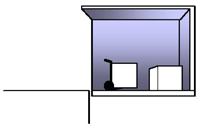
Most passenger elevator systems and standard freight elevators are designed as Class A, or “General Freight Loading”. The actual amount of a one-piece load being moved on to or off of the elevator cannot exceed 25% of the stated capacity of the elevator system. For example, although the capacity of the elevator may be 2,000 lbs (907 kg), the actual limit of a one-piece load is 500 lbs (226.75 kg). As well, the loading or unloading of the elevator is restricted to manual means or to a hand truck. In the event that a hand truck is used the weight of the equipment must be included as part of the 25% loading restriction.


Class B Loading

This class pertains to freight elevators that are intended for the transport of motor vehicles only, up to the stated capacity of the elevator system.


Class C Loading

NOTE: Class C loading is not permitted for accessibility lifts or for LULA elevators.

Class C1 Loading

This class allows industrial truck loading or unloading of the elevator system. The combined weight of the industrial truck and the load cannot exceed the stated capacity of the elevator. The loading device can remain on the elevator during operation.


Class C2 Loading

This class allows for the loading of the platform at 150% of the stated capacity of the elevator. In most cases, this allows for a one-piece load that equals the capacity of the elevator to be loaded with a forklift or motorized lift truck on to the platform of the elevator. The loading device must be removed prior to the operation of the elevator.


Class C3 Loading

This class allows for heavy concentration loading where the static load during loading and unloading does not exceed the rated load. The combined weight of the load and equipment must not exceed the stated capacity of the elevator system. In practice, Class C3 elevators are most often designated to support single piece loads equal to the capacity of the elevator.


Much of this information was taken from two web pages

www.delawareelevator.com & www.delta-elevator.com


If you have any questions or would like information from Colley Elevator you can go to www.colleyelevator.com, email Craigz@colleyelevator.com or call 630-766-7230.

Sunday, November 22, 2015

Escalator & Elevator safety tips & reminders

I recently read an article about a toddler in Dubai after getting her hand crushed in a high rise elevator.  Apparently a little girl stuck her hand between the elevator doors and the doors closed on her hand.   This is a reminder to pay attention when riding any conveyance and watch little ones. 


 Full article - http://gulfnews.com/xpress/dubai/news/girl-s-hand-crushed-in-elevator-accident-1.1613420

Last year we had a little person's hand get pinched by a door binder on the leading edge of the door as it was opening.  The door binder had been damaged by a mover and the building never had it repaired.  The door binder got damaged in between our visits and a little person got injured when their hands where by the door when it was opening.  What does this all mean?  Pay attention to your little people while riding elevators, it just takes a moment for something to happen. .  We should be riding in the middle of the elevator with hands away from any moving parts.  

Here are some tips to pay attention to when riding elevators.  

ELEVATOR
Don’t stop the doors from opening or closing
Never stick your hands or feet between the doors
Stand away from the doors
Take the stairs in case of fire
Locate the alarm button
Watch over children, never leave them unattended

ESCALATOR
Check the stairs direction
Never ride barefoot
Tie your shoes laces
Avoid carrying large bags
Stand in the middle of steps
Face forward, hold handrail
Watch out with loose clothing
Supervise children
Locate emergency buttons

Be mindful of these items when riding conveyances, while we do our best to provide safe transportation for all users the elevator industry needs your help to keep everyone safe!


Read more at the Elevator & Escalator safety foundation - http://www.eesf.org/safety/

The Elevator & Escalator safety foundation has a good amount of resources and does provide an education program for children, adults and college students.


If you have any questions or would like information from Colley Elevator you can go to www.colleyelevator.com, email Craigz@colleyelevator.com or call 630-766-7230.

Saturday, November 14, 2015

Elevator safety & freight elevators

Last week a 73 year old women fell down an freight elevator shaft in a two story building in Gaffney, South Carolina.  She told someone she was going to the 2nd floor and she opened a set of doors to access the freight elevator and she stepped in the hoist way and the elevator wasn’t there, the women died.  The link to the story is below.

http://www.wyff4.com/news/coroner-identified-volunteer-worker-killed-after-falling-down-elevator-shaft/36304554

The reason this resonated with me is recently we had a few buildings that have very old elevators.  One of the elevators we repaired the locks and they are currently working correctly the other building does not have the money to correct the safety issues with the elevator.  When I heard about this accident it hit home about why it is important to make sure we are making good decisions on our daily elevator inspections and we need to give building owners recommendations. 

Here is the predicament that older elevators have; they may be in buildings where there isn’t a lot of money to spend on the repair of the existing system and parts may not be available.   A complete freight elevator modernization is very expensive.

What do you do?  As an elevator contractor we need to give the building owner information for the repair of the system.  As a building owner they need to take these recommendations seriously and make the corrections.  If the building owner does not make the repairs to the elevator system you shut their elevator down and discontinue the service on the elevator system. 

How much is business worth?  I went to a building in 2014 and saw the elevators in the building.  The building wanted a repair on the elevator system.  After I saw the elevator system I sent a proposal to install a new elevator.  The building owner did not want to put a new elevator in.  A year later they called in an talked to another person at our company, before I knew it the person went to the building to look at the elevators and the building owner again "wanted a repair".  The building owner was calling anyone and everyone to come try and fix their elevator which needed to be replaced.  Again, we sent them a price for a new elevator system. Below you can see the elevators.

[Both elevators come down to the lowest landing, a person can easily go into the elevator pit, which is shallow, and the person would get crushed]

[This elevator machine served the building well for 80+ years but is in need of replacement]

As elevator professionals we are the people who can make the decisions on letting an elevator run or not, if it is not safe, shut it off.  Building owners, repairing the elevator system to be safe may be expensive but it is less than a serious injury or fatality at your building.  With this said, I am sending a quote out to a very old elevator that we shut off as they were running it with the gate open because a 2 speed manual horizontal gate is broken beyond simple repair. 


If you have any questions or would like information from Colley Elevator you can go to www.colleyelevator.com, email Craigz@colleyelevator.com or call 630-766-7230.

Sunday, November 8, 2015

Give building owners a reason to take care of their elevator system

I was at a building this week that reminded me that it is the responsibility of the building owner to hire good contractors and take responsibility for their building.  There are some building owners who do not want to spend any money on their buildings period, and have a revolving door of contractors.  

We got a call for a building owner on the North Side of Chicago who most likely got written up for a single bulk head cylinder by a City of Chicago Inspector.  It so happened that Colley Elevator installed this elevator in the mid 1960’s.  It so happens that all of the equipment on the elevator system is from the original installation.  For one moment let’s move beyond the fact that this elevator equipment needs to be replaced and is past its life expectancy and consider how amazing it is that the elevator has lasted over 50 years and is still servicing a building.  I do not believe that any of the equipment we are installing today will last close to 50 years.  Back in 1960 the equipment was engineered and installed to operate for 30, 40 or 50 years.   Hats off to everyone involved in the elevator trade when equipment was so robust it would last such a long period of time.  


Back to the building who needs the work.  I first looked in the pit and saw the pit was filled with oil and the solution to the oil filling up the pit was a vacuum.  The pit is so deep and apparently the issue is ongoing so the vacuum is left in the pit.  It appears the oil has gotten a bit out of hand.


I went into the machine room and found out there are no maintenance logs, no testing records, nothing besides a few old tags from companies who did something for the building at some time.   We take care of many older elevator systems that run decent and we give the building owners updates when they should replace the system.  It is up to the building owner to make a good decision for the building on what to do.  This is far from a terrible elevator system but it is an elevator system that has been neglected over the years and needs to be maintained properly.  This building owner most likely is not interested in doing anything besides the minimum that is required by the City of Chicago.

A building owner with a 5 story residential building that has 40-60 units in the building should have a monthly elevator maintenance agreement.  The building that we went to this week does not have any maintenance agreement and most likely calls the lowest price service provider to fix the elevator.  It is up to us as elevator professionals to encourage proactive maintenance and modernization of elevator systems.  There will be times where a building owner will not be interested in spending any money on their building.  We need to give them reasons why they should be spending money on their elevator system. If you are an elevator sales person, inspector or mechanic we need to encourage building owners to be responsible.

Reasons why you should have a maintenance contract

1.    Provide the building with a safe elevator system
2.    Provide the building owner with a reliable elevator system
3.    Provide the building owner with information on modernization of the elevator system
4.    Provide the building owner with information on mandates for their elevator system.
5.    Remove the frustration of having an elevator in a building by giving you long term solutions to the problems you are encountering.

That is a list of only a few reasons why to have a contract for elevator maintenance.  As an industry we need to go to the buildings that do not maintain their elevator system and show the building ownership why hiring an elevator contractor to have an invested interest in their elevator system is a good idea.  One trip and fall, one accident, one entrapment, or one repair expense due to neglect can not only cost the building money but it can also give the building a bad name and occupancy can fall.  Litigation for accidents and repairs are expensive and a good contractor can help you prevent these issues from occurring.

If you are a building owner that needs to find a good elevator contractor get in touch, if we are not a good fit for you building we can give you a recommendation of who can help you out.  As I have mentioned in previous posts not all elevator contractors are good at working with every elevator system.  Find a good company to take care of your elevator system. 


If you have any questions or would like information from Colley Elevator you can go to www.colleyelevator.com, email Craigz@colleyelevator.com or call 630-766-7230.

Sunday, November 1, 2015

Proprietary Elevator Equipment – choose Elevator Maintenance Company wisely

Last week I had information on firms in New York that have untrained people working on elevator systems that have had catastrophic issues.   This week will be short and will be about Elevator Companies taking on elevators they know nothing about and are not straight with building owners about their level of competency for that specific system.

With the growing amount of proprietary equipment and lag time in service tools being available to elevator personnel we run into many elevators that may not be a good fit for maintaining.  There are some elevators we decline and give our recommendation to stay with the original manufacturer or a company with a different skill set than our own and there are some that we preface our relationship with “there is a chance you may need to call the OEM if there are significant issues”. 

What we see on the street talking to building owners is that they are tired of being mishandled, overpaying, having a lack of communication, etc from large multinational elevator companies.  We take on elevator equipment that may be foreign to our company only when we tell the building ownership that while we can maintain the elevators, there is a slight possibility that we do not hold the resolution on this particular system if there is a significant issue.  Most building owners are fine with this and move forward with our company.

What I have been seeing more frequently is that there is not a conversation between the new vendor and the property manager for some buildings indicating that there are road blocks that we may not be able to handle.  When there isn’t clear communication about the possibility of not being able to fix the elevator it becomes a large issue when the elevator breaks and there isn’t a clear resolution.  I get a phone call saying "ABC elevator are having a problem with a Thyssen TAC 7 Million can you help us?  They say the elevator needs all new boards.  The elevator has been shut down for 3 weeks and they are quoting us $9,500.00.".   This is not a good scenario.

I was at a building on Friday that had a non-union company servicing the elevator system.  There was an issue with the first floor car button that the previous company could not remedy.  We got a call, I got a picture of the button, got the mechanic the button base and everything worked fine the next day.  The button had been a problem at the building for over a month. I was told from the building ownership during my visit that the non-union elevator company spent 4-5 hours trying to repair the button and could not get it to work.  The button base costs $25.00 and just needed replacement. 

I do not believe that collecting money from a building is a good business practice when you have no idea even how to change the buttons on the elevator system or to identify when a button needs to be changed.   When you are shopping for an elevator maintenance provider make sure they have worked on your equipment, if they have not make sure they give you a clear understanding of their capabilities so you do not get stuck with out a Plan B.   

If you have a good elevator maintenance company they most likely can take care of most of your elevator issues if they use their resources.  There are some times we cannot and the OEM will need to take over.  Make sure you have a company who will clearly communicate their limitations so no one is surprised.  If you have an honest hardworking elevator company in your corner they will give you good information on how to proceed.


If you have any questions or would like information from Colley Elevator you can go to www.colleyelevator.com, email Craigz@colleyelevator.com or call 630-766-7230.

Saturday, October 24, 2015

Elevator personnel licensing – New York

I was listening to the Elevator Radio Show podcast, elevatorradioshow.com, an article was mentioned form the Gothamist.com about “Should New York Elevator Mechanics be Licensed?”

Right now it appears [from the article] that anyone can work on an elevator in the State of New York.  I do not believe that is a good thing to give anyone the ability to work on a piece of equipment that has the potential of causing immediate catastrophic injury or damage with out proper training.


The Elevator Company who was involved with the building that recently had the accident in Williamsburg, Brooklyn also had an elevator death in August 2014.  The article also states that in May an Air Force veteran fell down 24 stories in the elevator shaft in a half built luxury hotel.  He was working on the elevator and did not have any formal elevator education.  On Christmas day 2010 an elevator accident occurred at SUNY Medical Center and the mechanic was untrained which led to the first conviction of an elevator mechanic in US History.

In Illinois we have a process to become elevator personnel.  In Illinois we have licenses for anyone who maintains, constructs, modernizes, services or inspects elevators.  To maintain these licenses we need continuing education.  As elevator professionals we are responsible for the safety of the riding public.  Our mistakes due to judgment failure or lack of knowledge can immediately harm a person.

I hope the State of New York takes a look at licensing elevator professionals long and hard to prevent unnecessary accidents from occurring.  No one should be working on an elevator system without the proper training; an untrained person can kill themselves or someone else.  While special interest groups may play a part in the licensing decision I give the advice to those who may be in a deposition or a part of an accident investigation in the future.  What will you say when you are asked “why didn’t you have a process for education, safety, training and removing unsafe equipment in place for conveyance systems.”.  An answer we heard in Illinois when a mandate occurred was “The mandated work is too expensive”.  The next question will be “how much is a life worth?”.  The answer that was given during this State of Illinois meeting was wrong.    

For building owners that have the decision on their elevator vendors, choose a vendor that has competent personnel and has a continuing education program.  Do not use a company that hasn’t been around, that doesn’t have qualified people, that does not have a continuing education program.  If you choose the wrong company to work on your elevator system you could have terrible consequences.

To put New York elevator personnel licensing in perspective in 2012 New City tried to restrict selling of “big gulp” sodas.  While large sugary drinks may be detrimental to our health over time, I believe having a qualified person working on the elevator system presents an immediate danger to anyone using that specific conveyance system.  Let’s take that soda energy and put it to some practical use, start with licensing elevator personnel.

Link to article


If you have any questions or would like information from Colley Elevator you can go to www.colleyelevator.com, email Craigz@colleyelevator.com or call 630-766-7230.

Saturday, October 17, 2015

Elevator cable lubrication & maintenance

At the last NAEC convention in Boston I had the opportunity to sit in on a cable lubrication seminar put on by Martin Rhiner of Brugg Lifting/Elevator rope.  The company I work for, Colley Elevator, does not maintain high rise buildings, however, we do low to mid rise traction elevators and we inherit buildings on maintenance that typically have deferred cable maintenance.  While I am getting more knowledgeable on traction elevators, my expertise is not in traction elevator so I try to sit in any educational opportunities available.  There is a wealth of knowledge within our industry so any chance I get to sit through someone talking about what they are experts in, it is great!

Over the years I have heard different takes on cable maintenance from mechanics, sales people, etc, many of these takes typically are close to being on the right path, but had some wrong turns that are detrimental in the cables life.  Many of the takes I have heard have a mix of good and bad practices. 

The big take away here is that once a cable begins to deteriorate it cannot go back to being a cable in good condition.  In this picture it shows once a banana is going bad, it cannot be brought back to its original condition, much like cables. 

Another large point was the lubricant being used on the cable.   These points are assuming you are using the proper lubrication.

1.    A lubricant keeps its chemical and physical properties for a long period of time.
2.    Does not affect the traction between rope and sheave
3.    Lubricates all rope components such as core, wires and strands.
4.    Minimizes rope and groove wear
5.    Protects ropes from the environment
6.    Prevents corrosion

Do not use
1.    Lubricant with bitumen
2.    Lubricants with Molybdenum, Telflon or Graphite – Impact on traction is unpredictable

Do use
1.    Factory applied lube and field dressing from the same manufacturer
a.    Guarantees compatibility of lubricants
2.    Key specifications
a.    ISO grade of 10
b.    Viscosity index[ASTM D-2270) of NO LOWER than 80
c.    Viscosity @104 degrees/40 degrees C CST/SUS(ASTM-D445/D2270) of 10/59

Moisture can drown a rope – Elevator cables are made of “bright” (uncoated) wires and vulnerable to the effects of moisture including

1.    AC exhaust into the hoistway
2.    Coastal air
3.    Fire extinguishers and sprinklers
4.    Touch

In the past I have had conversations with different consultants doing water damage audits and it is important that if the cables have been exposed to water during an event, they should be changed.  Get them on the list for damage and have them on the insurance docket.  If you do not replace them immediately you may inherit bad cables in the next time period and if it is covered in your maintenance agreement you might have a difficult conversation with the building owner in the future.  Bring it up right away and if insurance will not cover it or the building owner chooses to punt on the replacement at least you have brought it up.

There also is a difference between rouging and rusting. 

Rouging – A sign of internal rope deterioration
1.    Fine red oxide dust on rope surface[not rust]
2.    Indication of metal abrasion within rope
3.    Metallic powder deposits on surface
4.    Indication that core got wet
5.    Core is deteriorating – reduction in rope diameter
6.    A17.6 only allows half of the diameter reduction
                                        Other causes of rouging
Rust = Corrosion
1.    Corrosion on wire surface means metal is deteriorating.
2.    Wire surface is pitted
3.    Reduced strength and bending fatigue life
4.    Breaking strength is reduced
5.    Irregularities on wire surface will shorten rope life
6.    Lubrication cannot reverse the corrosion

When to apply field lube?  Once per year or every 250,000 cycles.  There are some good references to gauge how much lubrication is needed based on how much rope you have and the diameter of rope.  Over lubrication causes its own problems.
How to lubricate cable?  There are many ways we have lubricated cables in the past, some are ineffective and dangerous.  Do not use lube in a can it may have degreasers and most likely are not compatible with the existing lubricant on the rope.  Solvents/degreasers will deteriorate rope cable.  Most common and correct ways would be to use a paint roller or a permanent lubrication device.  You need to be careful when setting up the lubrication device to not have it in too deep on the cables.  The permanent lubrication device should be set away from the cables and not touch them.


[The picture above is the wrong way to install a permanent cable lubrication device]

How to clean cables?  This is a messy but necessary process.  If cables are maintained properly you should not have to clean cables.  Due to the hoist way environments and different lubrication methods the reality is that cleaning will be requited.


I would like to thank Brugg for taking the time to talk to us about cables because it is helpful to remind us of all the dynamics that go into cable maintenance.   Brugg does manufacturer cables in the USA in Rome, GA.   More information about Brugg at http://www.bruggcables.com/.


If you have any questions or would like information from Colley Elevator you can go to www.colleyelevator.com, email Craigz@colleyelevator.com or call 630-766-7230.